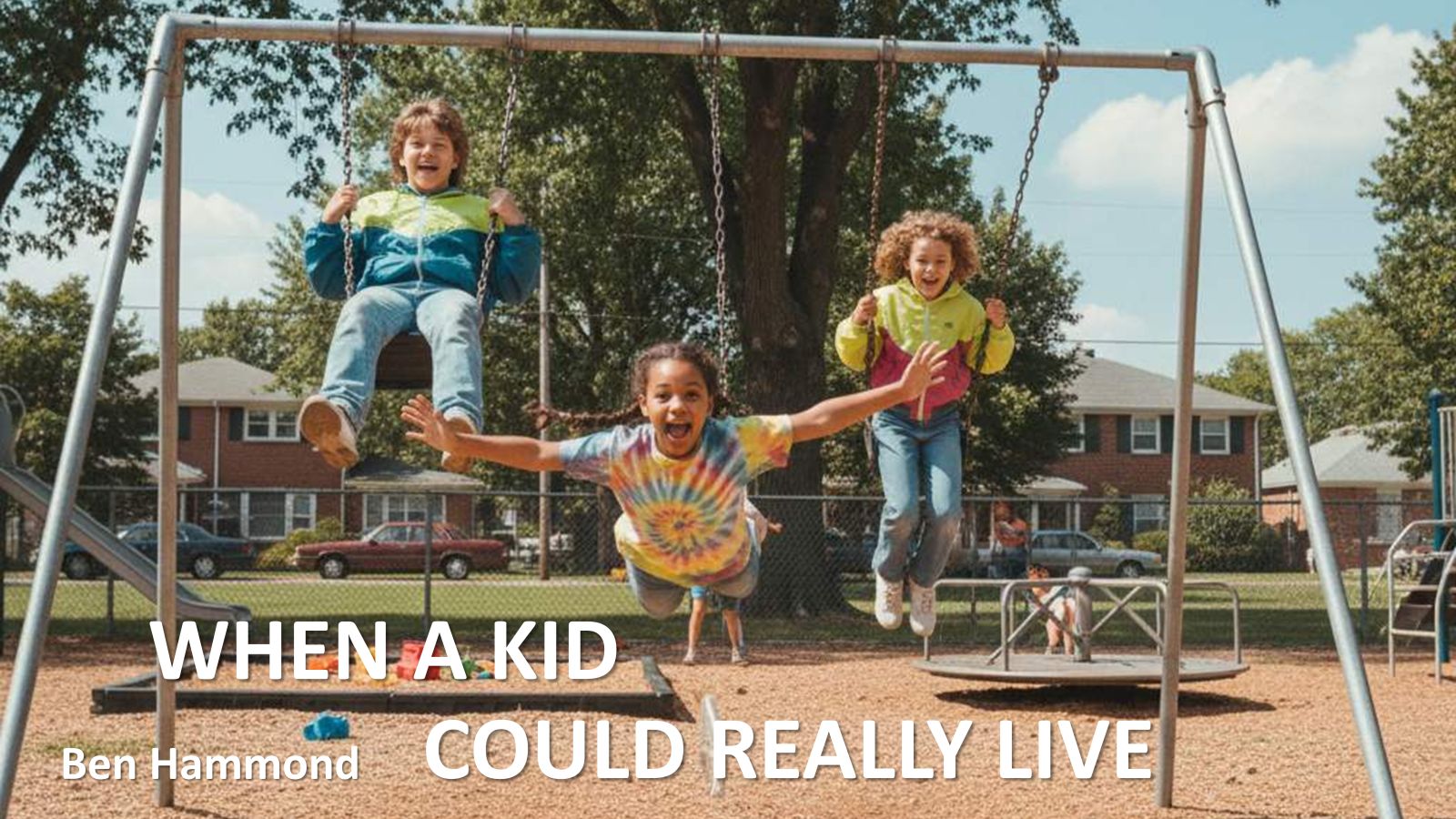
I grew up in the days when a kid could really live. Although my mom constantly worried, she naively sent us to the one place that posed the highest risk of our demise—the playground. While our anxious matriarch orchestrated every other minute detail of our safety, the playground was a free-for-all. Not only did it serve as the fulcrum of fun, but it strengthened our capacity for self-preservation. The playground of the 70’s and 80’s was more than a place for children to blow off some steam in a safe environment—it was an immovable death trap that boasted more hazards than the jungles of ‘Nam. There were more chances of death by hanging or decapitation than one would find in a Russian gulag. And we loved it.
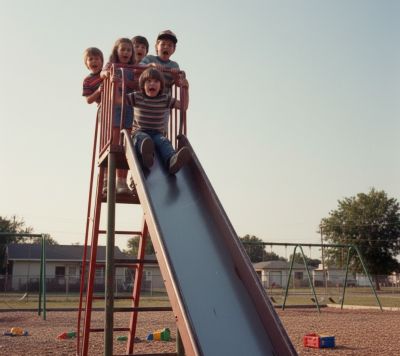 The majestic slide, towering high over its humble associates, assumed its rightful place as the king of the playground. With nothing to break our fall in case of a loose grip caused by a sweaty palm, we would climb straight up—twelve, fifteen, maybe twenty feet to the top, where we would find a small platform. From this lofty vantage point there were only two ways down. One was a backwards retreat down the stairs. Aside from the physics-defying gymnastic skills that such a feat would require, the string of other kids already ascending the stairs would never allow it. Their grimy faces streaked with snot and smiles mixed with ecstasy and trepidation looked up at you, encouraging—no—daring, you to take the dive. And, to avoid becoming the laughingstock of the neighborhood, you did. How mortifying it would have been at graduation to have a fellow classmate reminisce, “I remember little Benjie…he was too scared to go down the slide.” No, that just wouldn’t do.
The moment our bare legs hit the blistering steel of the sun-baked villain, we began to doubt our decision. But it was too late. Down we would go, the sound of sizzling flesh drowned out only by the screams of ecstatic children balancing on the razor blade edge separating mortality and immortality.
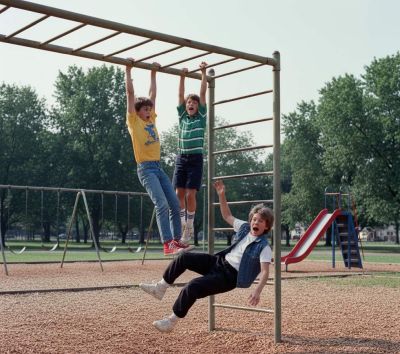 Speaking of danger, the monkey bars must have appeared on the playground in the dark of night, undetected by the adults. We had neither safety nets nor rubber mulch to soften our fall. We developed our athletic prowess by twisting ourselves into a pretzel to keep from hitting the hardened dirt where imprints of broken bones still silently called out the same “be careful!” admonition that we had dismissed when it came from our parents.
The monkey bars came in several varieties. Some consisted of nothing more than two vertical ladders connected by a mesh of horizontal bars. The most agile could walk across the top, but the rest of us could only swing hand-over-hand like the namesake monkeys—provided we had enough arm strength.
Others were shaped like a dome, which only made it harder for the adults to reach the crying child inside—the one that had succumbed to his mortal weakness of insufficient arm strength. Regardless of the structure of the monkey bars on any given playground, they were enjoyed by the kids, although usually the more athletic ones gravitated toward them. Not everyone could escape the embarrassment of a fall.
The swing, on the other hand, could accommodate all skill levels—even babies could use it with the correct seat. The real challenge, though, was seeing how high we could swing—especially if the set wasn’t anchored with concrete and we could get the back legs to jump off the ground. Speaking of jumping, that was the best part. What fun is it to slow down when you’ve finally got a good rhythm going? When we successfully reached the highest point forward we would go airborne, propelling ourselves as far as we could (a moment of silence for Jimmy who tried it on the backswing). Those who went down in history were the ones who could fly further than the others—and bonus points if you could do it without breaking a leg. Now, decades later, I have to wonder—did our parents know we actually did this?
Another exciting use of this versatile piece of equipment was that we could run under the swings while they were in motion. It took some skill to keep from getting pummeled into the ground by an 8-year-old on the downswing.
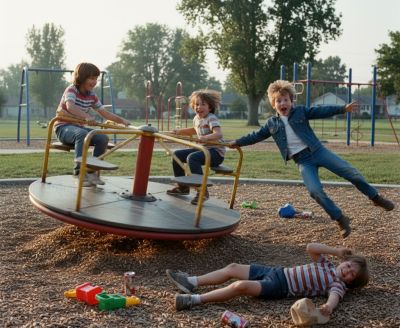 Although the slide stood tall as the king of the playground and the swing served as the most versatile, the prize for the most sinister piece of equipment goes to the seemingly unobtrusive merry-go-round. For those of us prone to dizziness, there was nothing merry about it. This spinning roulette wheel of doom, nothing more than a flat sheet of steel fitted with too few handlebars, sat off to the side, secretly obscuring its morbid tendencies. I’m guessing the adults did not even know what that thing could do. Once emancipated from post-adolescent oversight, we would load up all our friends and elect one or two of the most energetic as designated spinners. They took hold of a handlebar and ran as fast as they could until the whole thing was spinning at dizzying speeds. Ducking the barf slinging from their green-faced cohorts, the designated spinners would often try to mount mid-rotation. Sometimes they would make it. Sometimes they would bounce off and lie in the sand, barely clinging to life. Their friends would check their pulse later, but for now, the ride was all that mattered. The most agile could actually jump on and enjoy the ride with his friends. Every ride separated the lucky from the unlucky. Karma, maybe. Centrifugal force would claim the less fortunate, launching them into the air and pummeling them back to earth where they would wake up in the sand, panting next to the designated spinner who misjudged the revolving handlebars. The lucky, or should we say most dominant, in our circle of friends might find his way to the middle of the merry-go-round, where the spinning was the most docile. Not everyone was judged worthy of such a position—it was reserved for the popular, the athletic, or the bully.
Yes, those were the days—the days when a boy could be a man. And a girl could, also, providing she had the courage to take on the menacing metal monsters savagely awaiting their prey on the deceptively innocent school playground.