
When The Bunny Goes to Church
Every year she shows up at the mall, schools and even churches. Tall ears standing erect, children line up to have pictures with her. She is, after all, the Easter Bunny. Her presence, though, raises some questions. First, is she a she or a he? I am not sure, and I really don’t care, because we have bigger questions, like this one: should we even celebrate her? Should she show up at our Easter egg hunts? And about those Easter egg hunts…should we have them, especially in church? For that matter, should we even use the term Easter? These are serious questions that deserve serious answers. We do not want to invite pagan practices into the church, but neither do we want to abandon everything fun because someone came across something on the Internet that describes it as being from the Devil.
The only way to know for sure is to do a little study. So, let’s jump into the fascinating world of the Easter Bunny, Easter eggs, and the term Easter itself. Let’s start with the eggs.
The origin of Easter Eggs
How long have people been decorating Easter eggs? It’s hard to say. If you search the Internet, you commonly see a quote attributed to a German text from 1572 which reads, “Do not worry if the Easter Bunny escapes you; should we miss his eggs, we will cook the nest.” Whatever that means. The problem is that this quote never appears with any source or footnotes. Even our friend AI, embodied in Gemini and ChatGPT, cannot conjure up a source, claiming that there is no such sixteenth century quotation. That’s pretty good for systems that like to make up sources on the fly (hallucinate is the technical term). Gemini tried to be helpful, declaring that the phrase is most commonly attributed to “Aller Praktik Grobmutter” (The Grandmother of All Customs) by Johan Fischart, but further research cannot seem to locate this quote.
The oldest verified reference to the Easter egg is widely understood to be from Georg Franck von Franckenau in 1682. Before we get there, however, we need to stop off in 1617 to consider a quotation about (non-Easter) eggs that is later mentioned by Franck von Franckenau.
1617 – Ovi Encomium (Encomium on the Egg) by Erycius Puteanus
An encomium is a speech or writing that praises something highly. While we may not think of the egg as something worthy of great platitudes, Puteanus disagreed. He praised the egg as a great encapsulation of nature and creation. I tried unsuccessfully to find an English translation, and the Latin text I located is corrupted. Therefore, I could neither read nor translate the original source. However, in 1682, our friend Georg Franck von Franckenau stated in De Ovis Paschalibus that Puteanus makes mentions of colored eggs, quoting Puteanus as saying (note that I used Gemini to translate texts that I could not locate in English):
The egg is white; and yet it admits all colors: It can be written on, it can be painted, it can be dyed; and now yellow, now red, now blue, the national customs make them.[1]
While we have no context for his remarks, Franck von Franckenau speculates that “perhaps” Puteanus was referring to the coloring of Easter Eggs with that statement. However, we cannot be sure. The earliest sure reference we have to Easter eggs, then, is Franck von Franckenau, so let’s look further at his work.
1682 – De Ovis Paschalibus (On Easter Eggs) by Georg Franck von Franckenau
This German treatise on Easter eggs appears in Satyrae Medicae, which is translated as “medical collections.” Due to misunderstandings about Easter eggs, Georg attempted to set the record straight on them.
He began his essay by referring to “Paschal eggs” or Oster-Eyer (German for “Easter Eggs”), which are hard boiled and painted with various colors during the Easter holiday. As we saw above, He noted that Erycius Puteanus may have referred to them in his work Encomium on the Egg (Ovi Encomium), which was published in 1617. He then goes on to explain that these eggs are given to children by their godparents after baptism. Furthermore, he notes this procedure during the Russian Easter festival:
When they meet each other in the street, they greet each other with a kiss on the mouth and say: “Christ is risen! whereupon the other answers: Christ is truly risen.” It is also customary for no one to offer such a kiss and greeting without a colored egg.[2]
I spent 1997 in Russia as a short-term missionary, and I can attest that colored eggs are still very much a part of the Russian Orthodox Easter traditions. A Russian Easter service lasts all night (full disclosure: we popped in late and sneaked out early), and the priests bless eggs and small cakes that the people bring with them. They also give these eggs and cakes to others as gifts.
So, how did eggs come to be a “thing” in Easter celebrations? Georg offered some available options held by people of his day.
Option 1: The Jews
Georg Franck von Franckenau states that while no one seems to know where the egg tradition comes from, some do offer conjectures.
Most learned men confess that they are ignorant of the origin of these eggs. Conjectures, however, are offered. Some trace them back to the Jews. For they, at their Passover festival, among other very vain ceremonies, also have an egg boiled hard as a symbol… A hard egg signifies the sacrifices of the festival.[3]
This speculation arose because Jews include an egg (beitzah) on the Seder plate. No one seems to know why they do this, but many believe it is because when the Jews went to Jerusalem to celebrate festivals (Passover, Sukkot, and Shavuot), they were not to go emptyhanded. For Passover, when the Temple was standing, an offering called korban chagigah (pronounced hah-GEE-gah) was brought (in addition to korban pesach, the lamb). The korban chagigah could be any animal and was supposed to be enjoyed. In commemoration of the two offerings (chagigah and pesach), they would put two cooked foods on the plate[4] (egg and shank bone). Speculation is that the egg may have been used because it is easy to cook or that it is a symbol of prayer, mourning, escape from paganism, or hope for the future.[5]
Option 2: Heathenism
The second option that Franck von Franckenau gives is that the use of eggs comes from heathenism. He says this:
In former times, blind pagans held Circus Games, Egg Festivals, and Egg Games around this time of year, where they threw dice around eggs in an oval circus, in an egg-round place, in honor of the two Egg Gods, Castor and Pollux (born from an egg, by one Jove-Swan in Leda’s nest), from which Easter is named, and also among us Christians (whose fame is not least) a leaven has remained, that one also runs around the eggs on Easter Monday, but Christ has also consecrated his meaning to it and ordained that, after one had to abstain from such things and eggs for 40 days, and now on Easter Day the day is opened to eat meat and eggs, that one should carry the eggs into the churches and avoid them with superstitious ceremonies, like hidden trifles, etc.[6]
The last part leads us to the third option to consider for the provenance of the eggs.
Option 3: Plenty of eggs after Lent
Having abstained from eggs for Lent, they would be available in abundance, allowing for their use in the Easter celebrations.
The origin is also conjectured from the Lenten Fast by the Most Reverend and Most Excellent Mr. Joh. Lud. Fabricius, incomparable Theologian, our most honored Patron and Colleague, in his most learned letter to me of May 2nd. For although (he says) today, due to a general dispensation, it is permitted to eat eggs at that time, it was nevertheless strictly forbidden formerly. For the Synod of Constantinople, held in Trullo, Canon LVI, seriously enjoins both Laity and Clergy to abstain during Lent not only from meat, but also from milk and eggs. It is repeated in the decree, d. 4. c. 6. of Gregory I, Chapter to Augustine, Bishop of the Angles, the tenor of which is this: It is proper that on the days we abstain from the flesh of animals, we also fast from all things which have the seed of the origin of flesh, namely milk, cheese, and eggs. Since, however, when winter is over and spring begins, hens start laying very many eggs again; yet, since it was not permitted to enjoy them until Easter, a large quantity of them was preserved; which were then consumed all the more eagerly and plentifully. Or perhaps those hard-boiled eggs were preserved until it was permitted to use them during those very holidays, with a clear conscience, though not with a safe stomach; which could then also be given to priests and others.[7]
Here is Canon LVI from the Synod of Constantinople (AD 692) that he mentioned:
We have likewise learned that in the regions of Armenia and in other places certain people eat eggs and cheese on the Sabbaths and Lord’s days of the holy lent. It seems good therefore that the whole Church of God which is in all the world should follow one rule and keep the fast perfectly, and as they abstain from everything which is killed, so also should they from eggs and cheese, which are the fruit and produce of those animals from which we abstain. But if any shall not observe this law, if they be clerics, let them be deposed; but if laymen, let them be cut off.[8]
The point is that eggs were required to be avoided during Lent. However, the hens kept laying eggs, which means they had a surplus. When the restrictions were lifted at Passover, they were able to eat them and pass them along to others. This could be, then, the origin of making use of eggs at Easter.
Option 4: German feasts and collecting of eggs
Franck von Franckenau offers yet another possible source for the origin of Easter eggs, pointing to German feasts and egg collection traditions.
During those festivals which immediately follow the Lord’s Day of Resurrection, feasts are held in many regions of Germany, which consist almost entirely of eggs and certain honey cakes and pastries. And in many places, when the schoolboys sing that hymn: Christe qui lux es et dies, then the rest of the crowd of boys and girls also collect eggs from house to house, especially from those who lifted them from the sacred font, and then eat them together, which they commonly call Osterim (Easter meal). The eggs themselves thus collected, almost begged for, they call as if Eyer-betteln (egg begging), because they were accustomed to feast together with these eggs, collected and gathered as symbols.[9]
Easter remains a big celebration in German-speaking countries. Germans celebrate Easter with two national holidays—Good Friday and Easter Monday, usually with paid time off.[10] On Good Friday, the Germans do not eat meat, with the exception of Maultaschen, which is a meat-filled noodle (like a ravioli). Legend has it that naughty monks found a way around the no-meat rule during Lent by concealing the meat in the noodle, thus hiding it from the eyes of God.
The Germans also still celebrate with colorful eggs. They color and hide them just like we do in America.
Option 5: An emblem of the Resurrection
Franck von Franckenau continues with his Easter egg origin options, admittedly offering some speculation.
It may perhaps also be possible to make a conjecture here, namely, that eggs are offered as an emblem of the Resurrection. Also because everything arises from the egg.[11]
He quotes Macrobius as saying this (from Saturnalia, Book VII.16.6, 431 AD):
Nor inappropriately would I compare the egg to those things from which all things come, as Cleanthes did. For in every kind of living creature which is born from coition, you will find the egg to be the principle of some, like an element. For living things either walk, or crawl, or live by swimming or flying. Among walkers, lizards and similar creatures are created from eggs. Those which crawl are born with the egg as their beginning. All flying creatures proceed from eggs.[12]
We will return to Franck von Franckenau in a minute, but first let’s look at Macrobius ourselves. Note that his work is called Saturnalia, was the name of the ancient Roman festival honoring Saturn, the god of agriculture. It was celebrated near winter solstice, and may be the origin of many of our Christmas traditions (e.g. feasting, gift-giving, wreaths).
1. In Saturnalia, Macrobius describes the importance of the egg, sparking the never-ending debate over whether the chicken or the egg came first.Meanwhile, Euangelus, envying and mocking the glory of the Greeks, said: “Away with these things which are debated among you for the display of your wordiness! Rather, if your wisdom is good for anything, I want to know from you: did the egg exist first, or the hen?”
2. “You think you are making a joke,” said Disarius, “and yet the question you have raised is worthy of inquiry and knowledge. For, preparing a joke for yourself based on the triviality of the matter, you have asked whether the hen began from the egg or the egg from the hen; but this must be inserted into serious discourse in such a way that it should be debated even anxiously. And I will put forth what occurs to me to be said on both sides, leaving it to you which of them you would prefer to seem more true.”
3. “If we concede that all things that exist began at some point, the egg will rightly be judged to have been made first by nature. For what begins is always still imperfect and formless, and is shaped to its perfection by the additions of progressive skill and time. Therefore, nature, fashioning a bird, began from an unformed beginning, and produced the egg, in which the form of the animal is not yet present; from this, the form of the perfect bird came forth by the gradually proceeding effect of maturity.”
4. “Furthermore, whatever is adorned by nature with various embellishments undoubtedly began from a simple form, and was thus varied by the addition of complexity. Therefore, the egg, simple in appearance and created with the same form all around, came first, and from it was completed the variety of ornaments that constitute the species of the bird.”
5. “For just as the elements existed first and then the remaining bodies were created from their mixture, so the seminal reasons (or principles) which are in the egg, if this transference is pardonable, must be believed to be, as it were, certain elements of the hen.”
6. “Nor would I inappropriately compare the egg to the elements from which all things come: for in every kind of living creature which is born from coition, you will find that the egg is the beginning of some, after the manner of an element. For animals either walk, or crawl, or live by swimming or flying.”
7. “Among those that walk, lizards and similar creatures are created from eggs. Those that crawl are born with an egg as their beginning. All flying creatures proceed from eggs, except for one which is of an uncertain nature: for the bat does indeed fly with leathery wings, but it should not be counted among flying creatures, since it walks on four feet and gives birth to formed young, which it nurses with milk. Nearly all swimming creatures arise from the eggs of their own kind, but the crocodile even from shells, like those of flying creatures.”[13]
Now back to Franck von Franckenau. He continues…
This is established by the more recognized authorities, Harvey, Hornius, Graf, Swammerdam, Kerckringius, Bartholinus, Jarmannus and others (we discussed the ovary of women in Diss. Med. Contin. IV. §. 2. Anno 1674) who rightly state that man himself and all animals (nay, I add, all living bodies) are generated from an egg. And how we can learn eternity from an egg is cited from Puteanus by the famous M. D. Omeisius in Prolus. Acad. IV. f. m. 28.[14]
His point is that the fact that life begins with an egg may be the reason that eggs are used around Easter—they symbolize new life and therefore the Resurrection.
Leaving the options for the origin of Easter eggs, Franck von Franckenau goes on to describe a practice in Germany that included a hare (Osterhase, or Easter Hare). There was a fable that this hare would hide its eggs (Hasen-Eyer, hare’s eggs) in gardens, grass, and thickets for the children to find.
In Upper Germany, our Palatinate, Alsace, and neighboring places, as well as in Westphalia, these eggs are called die Hasen-Eyer (The Hare’s Eggs), from a fable with which they impose upon the simpler folk and children, that the Hare (Der Oster-Hase – the Easter Hare) lays such eggs and hides them in gardens, in the grass, in thickets, etc., so that they may be diligently sought out by the children, with the laughter and joy of the elders.[15]
Franck von Franckenau does not specifically say that the Germans hid eggs, but it is assumed (and we know it is true from other sources) as he proceeds to rant against people gorging themselves on the eggs because he has observed many physical problems from doing so. Then he returns to the Easter eggs themselves.
Now we come to consider the Paschal eggs themselves. For by this name, the Italians call hard eggs, because they are offered to the priest to be blessed on Easter day, as Jonston writes Idea Hygien. p. m. 163. The Germans call them Eyer, Oster-Eyer (eggs, Easter eggs), the French oeufs durs (hard eggs), or oeufs de Pâques (Easter eggs), as Quercetus Diat. p. m. 400. The Greeks call them ephtha (boiled), see Symeon Sethi Alim. lit. . p. 170. Galen calls them (roast, see §. 17), writes Jonston, which, however, I could not find anywhere, unless it is a typographical error.[16]
Conclusion on the Easter Egg
Our deeply engaging foray into the origin of the Easter egg has, unfortunately, come up inconclusive. Easter eggs have been around for hundreds of years, and no one seems to know for sure how they got here. They might have pagan origins, and they might not. It could also be that they developed into an object of celebration over time from various sources. Pagans and Christians alike could have recognized the life-producing value of the egg and independently included them in their traditional celebrations. Therefore, I see no problem with continuing the tradition. Just make sure your kids know that bunnies do not, and cannot, as a matter of biological reality, lay eggs.
Now we have one more stop before we tackle the Easter bunny. What about the term Easter itself?
The Term Easter
The origin of the term Easter is (like everything, it seems) a debated topic. As is the case with its leporine mascot, no one seems to know for sure how we got it. According to the dictionary, the etymology of Easter is as follows:
Middle English estre, from Old English ēastre; akin to Old High German ōstarun (plural) Easter, Old English ēast east.[17]
Note that the word comes from Middle and Old English and is “akin” to (rather than deriving from) Old High German.
There does seem to be an obvious connection between east and Easter. We see basically the same thing in German. Ostern (Easter) is linked to the German word for “east,” which is osten. The east would be der osten. Therefore, both Easter and Ostern have an ancient relationship with east. But why? As we will see, we have to engage in a certain measure of speculation when it comes to archaic languages. However, many see a connection between the sun rising in the east, bringing on the dawn of a new day, and by extension, new beginnings. The month of April, being spring, also brings about new life, thus the Julian calendar’s depiction of it as Esturmonath.
It will help to understand something about how both English and German showed up on the world scene. One did not come from the other; they are, in fact, cousins, sharing the ancestry of the Proto-Indo-European (PIE) language, from which came most European languages (Greek, German, Latin, etc.).
A linguistic journey
Common ancestor: Proto-Indo-European (PIE)
About 5,000 years ago, people north of the Black Sea are presumed to have spoken PIE. Of course, PIE no longer exists, but linguists have reconstructed it based on the languages that derived from it. I would think it is likely that it was one of the new languages that appeared at the Tower of Babel. Linguists believe that out of PIE came many other early languages, such as Proto-Germanic, Proto-Italic, Proto-Greek, Proto-Indo-Iranian, Proto-Celtic, Proto-Slavic, and Proto-Greek. It is the Proto-Germanic branch from which both English and German come.
Common ancestor: Proto-Germanic (500 BC – 200 AD)
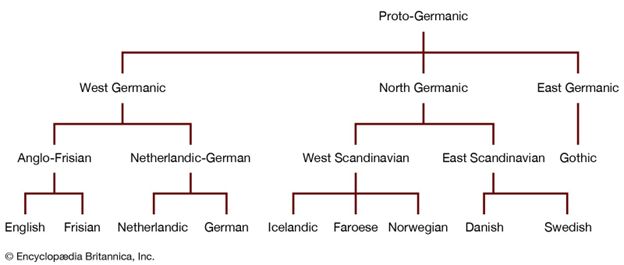
Proto-Germanic is believed to have been spoken from about 500 BC to 200 AD in the area of Scandinavia, Denmark, and northern Germany. Proto-Germanic gradually split into branches:
- Proto-North Germanic
- Proto-West Germanic
- Proto-East Germanic
Both English and German came from the Proto-West Germanic language.
Common ancestor: Proto-West Germanic (200 AD – 500 AD)
The following graph[18] from Britannica gives a general idea of how the Germanic languages came into being. The corresponding article emphasizes, however, that such a diagram overemphasizes the language splits, because, in reality, they were more gradual than depicted.[19] We also must keep in mind that these older “languages” are general reconstructions and could be better defined as “linguistic groups.”[20]
The Anglo-Frisian languages
The Frisian languages today make up three languages. They get their name from the area that used to be called Frisia, which is in the North Sea coasts of modern-day Germany and the Netherlands (early to late Middle Ages).[21] The remaining languages are West Frisian (Frysk), North Frisian, and Saterland Frisian. These are the most like English of any other language and are considered endangered.
Our interest, however, is in the English branch. In the 5th century AD (first recorded 449 AD), the Angles crossed the English Channel from what is today Germany and Denmark and invaded the island of Britain. Later the Saxons and Jutes also crossed into Britain. These groups fought the Celts, who had been living in Britain (and speaking a Celtic language). Most of the Celts died, but some escaped to live in what would become Wales. The Angles, Saxons, and Jutes spoke similar languages and these eventually mixed into what has become known as Anglo-Saxon or Old English.
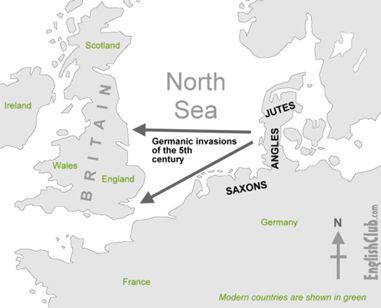
Map source[22]
Old English: 450-1100 AD
Old English continued to evolve, thanks in part to invasions by the Vikings from Denmark, Norway, and other northern countries from about 793 AD to 1066 AD.
In the 8th century AD (first recorded 793 AD, last in 1066 AD), the Vikings (from Denmark, Norway, and other northern countries) raided Britain. Some of the Vikings stayed in Britain, and we get some of our words (sky, leg, skull, egg, crawl, lift, take) from those northern countries.[23]
In 1066 AD, William the Conqueror led the invasion called the Norman Conquest. The Normans were French-speaking people from Normandy (north part of France). They began to rule Britain, making French the language of the ruling class, while most of the people continued to speak Old English. English, of course, began to take on some French words (damage, prison, marriage, jury, parliament, justice).[24]
Over the next couple hundred years, the French spoken by these Norman rulers in Britain changed English to the point where it is now called Middle English.
Middle English: 1100-1500 AD
Pronunciation began to change in Middle English, with vowels being pronounced shorter (known as “the great vowel shift”).[25] Over time, this began the rise of Modern English, which linguists have divided into “early” and “late.”
Early Modern English: 1500-1800
Late Modern English: 1800-present
This brings us to where we are now, speaking “Late Modern English.”
Now that we have survived this expedition into the intricacies of language evolution, you might need a refresher on exactly why we took the time to do this. It was because we want to know the origin of the word Easter. Did it come from a pagan goddess or not?
The German word for Easter is Ostern. Therefore, we may be tempted to assume that Easter came from Ostern. However, our linguistical journey reveals that Easter and Ostern grew up as cousins, connected by their ancestors but separated by countries. One did not derive from the other; both developed from the same ancient root.
The first time we have any record of a similar word appearing in English to refer to the Easter holiday is by “The Venerable Bede.” Apparently, if your name is lost to history, you get to choose an honorific title. In 725 AD, Bede wrote (in Latin) De temporum ratione (The Reckoning of Time). In it he mentioned that the Old English word for April was Esturmonath. This would have been the fourth month in the Julias Caesar’s Julian Calendar, which was used in England from 45 BC to 1752 AD (when Pope Gregory XIII’s Gregory Calendar began to be used). Bede begins his discussion of the English months this way:
In olden time the English people – for it did not seem fitting to me that I should speak of other nations’ observance of the year and yet be silent about my own nation’s – calculated their months according to the course of the Moon. Hence, after the manner of the Greeks and the Romans, [the months] take their name from the Moon, for the Moon is called mona and the month monath.
The first month, which the Latins call January, is Giuli; February is called Solmonath; March Hrethmonath; April, Eosturmonath…[26]
He then describes the origin of the name Esturmonath:
Eosturmonath has a name which is now translated ‘‘Paschal month,’’ and which was once called after a goddess of theirs named Eostre, in whose honour feasts were celebrated in that month. Now they designate that Paschal season by her name, calling the joys of the new rite by the time-honoured name of the old observance.[27]
Note that there is no record of Esturmonath (aka Eosturmonath) in English outside of Bede—no texts, no calendars, no poems, no legal writings, no emails, no nothing. All we have is Bede making the claim, some time later, that the Old English used this term and that it was connected to a goddess Eostre.
The identification of Eostre (or Ostara, a more modern name) is difficult because the only place we find her is in Bede’s writing, leading some to question whether she actually existed or if Bede was simply sharing the gossip of the day–or that he made her up for some inexplicable reason.
Jacob Grimm, in his 1835 Deutsche Mythologie (German Mythology or Teutonic Mythology), discusses German goddesses (chapter 13), quoting Bede’s references to two of them—Hruoda and Ostara.
The two goddesses, whom Beda cites very briefly, without any description, merely to explain the months named after them, are Hrede and Eástre, March taking its Saxon name from the first, and April from the second.[28]
As for the second goddess, Eostre, Grimm sees verification of her existence in the month of April.
We Germans to this day call April ostermonat, and ostarmanoth is found as early as Eginhart. The great Christian festival, which usually falls in April or the end of March, bears in the oldest of OHG. remains the name ostará . . . it is mostly found in the plural, because two days were kept at Easter. This Ostara, like the AS. Eástre, must in the heathen religion have denoted a higher being, whose worship was so firmly rooted, that the Christian teachers tolerated the name, and applied it to one of their own grandest anniversaries. All the nations bordering on us have retained the Biblical ‘pascha’; even Ulphilas writes paska, not áustrô, though he must have known the word…[29]
Then he posits a possibility for the use of her name by Christians…
Ostara, Eástre seems therefore to have been the divinity of the radiant dawn, of upspringing light, a spectacle that brings joy and blessing, whose meaning could be easily adapted to the resurrection-day of the Christian’s God. Bonfires were lighted at Easter, and according to a popular belief of long standing, the moment the sun rises on Easter Sunday morning, he gives three joyful leaps, he dances for joy. Water drawn on the Easter morning is, like that at Christmas, holy and healing; here also heathen notions seem to have grafted themselves on great Christian festivals. Maidens clothed in white, who at Easter, at the season of returning spring, show themselves in clefts of the rock and on mountains, are suggestive of the ancient goddess.[30]
Because we only know about Eostre through Bede’s writings, we may question her existence. Therefore, Grimm goes on to vouch for Bede’s character. Surely a guy so venerable would not make up something like this.
It would be uncritical to saddle this father of the church, who everywhere keeps heathenism at a distance, and tells us less of it than he knows, with the invention of these goddesses. There is nothing improbable in them, nay the first of them is justified by clear traces in the vocabularies of other German tribes.[31]
A few decades later, Adolf Holtzmann wrote his own Deutsche Mythology (1874), in which he also tackled the idea of Ostara.
The name of this goddess has been preserved in the festival of Easter (Osterfest). It is certainly very striking that one of the highest Christian festivals is designated by the name of a pagan goddess; it proves that our Christian Easter falls at the time of a festival once dedicated to Ostara, and that the veneration of this goddess was so deeply rooted that it was impossible for Christian missionaries to introduce a Christian name, such as Pascha (French Pâques), for the old name Osterfest…
It is all the more striking that we know almost nothing more about a goddess whose cult and name could not be displaced, and to whose celebration one of the highest Christian festivals had to yield. Here we see how meager our sources are, and how much we must lament that all literature was in the hands of the clergy. While the entire populace still knew the goddess Ostara—and undoubtedly her history and myths—not a single writer tells of her; indeed, that Ostara was truly a goddess might be doubted if we did not, fortunately, have a testimony for it in Bede the Venerable.[32]
K. A. Oberle, a German folklorist, writing in 1883, also commented on Ostara, also noting that we only know about her from Bede.
That Ostara was truly a goddess might itself be doubted, if we did not have the testimony of the Venerable Bede for it, but only this (de temp. rat. cap. 13).[33]
We should also note that Bede seems to indicate that the term Esturmonath was no longer used in his day. Whether it was still in use or not is impossible to decipher because the dated documents we have from that period generally use the Latin term, Aprilis, as almost all the writing we have is in Latin. English seems at that time to have been a spoken language while the writing was done in Latin (even in England).
The Old English Martyrology is about the oldest English text still extant today. It was a reference work similar to an encyclopedia, written in Old English, and written/compiled in the latter part of the ninth century (850-900 AD). This work used the Latin term Aprilis when referring to the fourth month. This would indicate that by this time, Esturmonath was no longer in use.
It seems likely that by Bede’s time, even spoken English employed the term Aprilis for the fourth month. However, he made an interesting statement: “Now they designate that Paschal season by her name, calling the joys of the new rite by the time-honoured name of the old observance.” While the connection to Eostre in relation to the fourth month had died out, Bede claimed that it lived on in celebration of the Paschal season, which we know as Easter. The old observance, according to Bede, was worship of Eostre. The new “rite” was celebration of the resurrection of Jesus. The name remained, while the observance was gutted of its old meaning and replaced with something entirely new. It was as if a brothel were to shut down and the building bought by a church. The address, known far and wide as being connected to debauchery, was still in use, but for a different purpose. We could argue that we should change the name to divest from any connection to the former sin, or we could argue that we have defeated evil by planting our Christian flag on the field of paganism, reclaiming it for God’s glory. You can make that decision for yourself.
In case our little linguistical journey has proved somewhat confusing, let me sum it up this way: it is possible (maybe even likely) that the term Easter has ancient roots in the worship of the goddess Ostara, or Eostre. However, the connection between the name and the goddess died out centuries ago. The name became an empty shell and was replaced with something more meaningful, and, in fact, real.
So, let’s come to the practical aspect of this. Should we use the term Easter?
To answer this question, we might consider Paul’s letter to the Corinthians. The great apostle claimed that he would not eat meat if it were to cause his friends to return to their former pagan lifestyles of eating meat that had been sacrificed to idols. Otherwise, he would dig in. If using the term Easter would send you back into the worship of Ostara, which fizzled out centuries ago, I would stop. If not, I’ll plan to continue using it, having stripped a pagan goddess of her name and putting it to use in the service of God.
Before we leave this subject, you might find it interesting to note that Adolf Holtzmann, in his 1874 Deutsche Mythology, described what he viewed as the origin of holding plays at Easter (maybe the precursors of our Easter pageants).
From 13th-century poems… it appears that in spring the population celebrated a great festival with outdoor dancing, which did not have the character of a simple spring festival, but a festival of love. Mention is made of the Ostersahs (Easter knife/sword), perhaps referring to ancient sacrifices. An “Easter Play” (Osterspil) was performed, consisting of a dance with dialogue. These pagan Easter plays were so popular that the Church had to tolerate them, attempting to give them a Christian meaning. Thus, it became customary to perform plays in the church during Easter time. Naturally, these took the Christian Passion and Resurrection as their subject; yet even in these, the old pagan elements could not be avoided.
Lively characters always played a large role: first the merchant from whom the women buy ointment; a favorite figure was Mary Magdalene before her conversion, who had to sing traditional love and spring songs. Some of these are of significant poetic value—imitations of old pagan poems with the pagan references removed. Even the Devil was likely assigned elements from the old Easter plays. One sees clearly that the Church resisted this “mischief” and only reluctantly permitted it because they could not change it. The medieval drama thus has its origin in the Germanic Easter play.[34]
Is there a connection between Easter and resurrection?
Some speculation exists that the name Easter is connected to the idea of resurrection. Of course, we celebrate the resurrection of Jesus on Easter, but our concern here is etymology. Some see the German-English ancestral relationship as pointing directly to the idea of resurrection. Let me explain.
The German word auferstehen means “to rise again.” If you were in Germany, you may get up early on Easter Sunday morning and shout “Christus ist auferstanden (Christ is risen)!”
Auferstehen is comprised of auf (denoting upward movement) and erstehen – (arise, purchase, come into being).[35] Some see the connection between osten (east) and erstehen (arise) because both are related to the rising of the sun. The sun rises (erstehen) in the east (osten). However, they come from different roots, so, although they may have some similarities, they are unrelated. Remember that Easter and osten are related, so if osten is not related to erstehen, then Easter is not either.
It seems to me, then, that the connection between Easter and auferstehen is unlikely.
What about Ishtar?
It is widely claimed that the word Easter comes from Ishtar, a Mesopotamian goddess of love, fertility, sex, and war. Although the words Easter and Ishtar sound similar, they have no connection. Ishtar is an Akkadian word that comes from the Afro-Asiatic family, whereas Easter is a German/English word that comes from the Indio-European family. The two have no interrelated roots.
The Origin of the Easter Bunny
Now we get to the Easter Bunny herself (or himself—not really sure). What we find is that our furry friend is actually an immigrant from Germany. Let’s look into some historical sources to trace the bunny’s immigration pathway.
1682 – Georg Franck von Franckenau
As we saw above, Franck von Franckenau describes a practice in Germany that included a hare (Osterhase, or Easter Hare). There was a fable existing at his time that this hare would hide its eggs (Hasen-Eyer, or hare’s eggs) in gardens, grass, and thickets for the children to find.
In Upper Germany, our Palatinate, Alsace, and neighboring places, as well as in Westphalia, these eggs are called die Hasen-Eyer (The Hare’s Eggs), from a fable with which they impose upon the simpler folk and children, that the Hare (Der Oster-Hase – the Easter Hare) lays such eggs and hides them in gardens, in the grass, in thickets, etc., so that they may be diligently sought out by the children, with the laughter and joy of the elders.[36]
He does not give any indication of where the fable originated or how a hare came to be connected to Easter, but we can see that at least in his time there was some kind of mythical creature that we might call an “Easter Bunny.”
1874 – Adolf Holtzmann – Deutsche Mythologie
Adolf Holtzmann, in his Deutsche Mythologie (German Mythology), mentioned an Easter Hare and speculated that it was the sacred animal of the goddess Ostara.
The Easter Hare is inexplicable to me; the hare is likely the animal of Ostara; on the image of Abnoba [a Gaulish goddess], a small hare is present. However, a hare has not appeared anywhere in German mythology up to now; in Indian mythology, there is a hare in the moon; the moon is called s’asadhara (Hare-bearer).
Incidentally, the hare must have been a bird, since it lays eggs; perhaps Easter eggs do not even go back as far as paganism; for with Easter, the fasting ends, and it is an old custom on Easter Eve to consecrate eggs and meat in the church, and the children then receive such consecrated eggs.
However, the fact that a nest is made for the children the evening before, so that the hare can lay the eggs in it—that does seem to be a heathen concept. — The hare of Boudica, Dio Cassius LXII 6, 1. [37]
He quotes Cassius Dio (Lucius Cassius Dio, AKA Dio Cassius) who admits that while he does not know the origin of the Easter Hare, he refers to it as a “heathen concept,” alluding to Queen Boudica (AKA Boudicca, Buduica), the queen of an ancient British Iceni tribe, who led her people against the Roman forces around AD 60-61. In Roman History, book LXII (which he wrote between 202 and 229 AD), Dio Cassius relates the story of Boudica, who gave a long speech rallying her countrymen against the Romans who were laying on them extravagant taxes, claiming that they were more powerful than the Romans.
When she had finished speaking, she employed a species of divination, letting a hare escape from the fold of her dress; and since it ran on what they considered the auspicious side, the whole multitude shouted with pleasure, and Buduica, raising her hand toward heaven, said: “I thank thee, Andraste, and call upon thee as woman speaking to woman…[38]
The queen saw the direction the hare ran as a sign that her people would be successful in the battle. Holtzmann speculated, then, that the use of the hare was a pagan concept, because Boudica used a hare in divination to her goddess. The “Andraste,” to whom Boudica prayed, is not mentioned in any other source, so we know nothing about her.
Unfortunately, then, we must sympathize with Dio Cassius and hold loosely our understanding of the birth of the Easter Bunny. We do know that the modern notion of the bunny is Germanic and there is at least some indication that the notion of a hare was integrated with paganism at some point. Whether our long-eared friend or its cousins came out of paganism is difficult for us to determine.
Why a bunny and eggs?
We all know (most of us, anyway), that rabbits do not lay eggs. How is it, then, that we combine a rabbit and eggs in our traditions? While none of us today claim that the Easter Bunny lays the Easter eggs, there are some stories that claim that the Easter Hare of old did lay eggs. That’s because she was once a bird, but the goddess Ostara transformed her into a quadruped.
Of course. Makes perfect sense.
In 1883, H. Krebs wrote a note about the Easter Hare in The Folk-lore Journal, quoting a book by K. A. Oberle (which was a new book at the time):
Easter-Eggs and the Hare.—Some time ago the question was raised how it came that, according to South German still prevailing folk-lore, the Hare is believed by children to lay the Easter-eggs. I venture now to offer a probable answer to it. Originally the hare seems to have been a bird which the ancient Teutonic goddess Ostara (the Anglo-Saxon Eàstre or Eostre, as Bede calls her) transformed into a quadruped. For this reason the Hare, in grateful recollection of its former quality as bird and swift messenger of the Spring-Goddess, is able to lay eggs on her festival at Easter-time (r. Oberle’s Ueberreste germanischen Heidentums im Christentum, 8vo, Baden-Baden, 1883, p. 104.)[39]
So, did Oberle really say that the hare used to be a bird? Here are Oberle’s words:
The hare seems to have originally been a bird, which the goddess transformed into a four-footed animal; therefore, in grateful memory of his former nature as a bird, he can lay eggs at the festival of the goddess. [40]
So, in 1883, Oberle thinks the hare seems to have been a bird. But where did he get that? He doesn’t say, although he does claim (in his preface) to trust Holtzmann, as well as others, for his information.[41] Apparently, nobody knew for sure how a hare came to be connected with eggs.
The Easter Bunny in America
Since the Easter Bunny carries German ancestry, how did it end up in America? Like everything else surrounding this character, details are sketchy. However, in 1757, a Fractur artist (an American folk-art style popular with Pennsylvania Germans in the 18th-19th centuries) named Conrad Gilbert emigrated from Germany and affiliated with the Pennsylvania Dutch community. Lest we be confused, note that the term “Pennsylvania Dutch” refers to the Pennsylvania Germans. It is thought to be a mistranslation of Deutsch (German). Somewhere around 1778, Gilbert drew a picture of a bunny with eggs, likely for a student at a school where he served as the schoolmaster around Orwigsburg, PA. We cannot know for sure if this was the first appearance of the Easter Bunny in America, but it does verify that at least someone in America knew of the Easter Bunny at that time.
The Easter Bunny, or Easter Hare, now shows up at schools, neighborhood parks, malls, and churches. Her obscure history leads some to reject her as a pagan symbol—an unnecessary and misguided display of syncretism. Others see her (and the eggs that inevitably accompany her) as a fun addition to a holiday that carries a much deeper and significant meaning.
Whether we employ the Easter Bunny, Easter eggs, or the term Easter in our celebrations, we must always remember the real reason that we hold the celebration is to commemorate the Son of God who came to earth and gave His life as a substitute for mankind. In His death and resurrection, He both experienced and defeated death, providing rescue from God’s wrath and eternal salvation for all who believe.
Endnotes
[1] Georg Franck von Franckenau, De Ovis Paschalibs, in Satyrae Medicae, Continuatio XVIII, 1682, §. 1, trans. Gemini AI.
[2] Ibid., §. 2.
[3] Ibid., §. 4.
[4] Yehuda Shurpin, “Why the Egg (Beitza) on the Passover Seder Plate?,” Chabad.org, accessed January 15, 2026,
https://www.chabad.org/holidays/passover/pesach_cdo/aid/3295864/jewish/Why-the-Egg-Beitza-on-the-Passover-Seder-Plate.htm
[5] Ibid.
[6] Franck von Franckenau, De Ovis Paschalibs, §. 5, trans. Gemini AI.
[7] Ibid., §. 6.
[8] Trullo, “The Canons of the Council in Trullo,” EWTN, accessed January 15, 2026, https://www.ewtn.com/catholicism/library/canons-of-the-council-in-trullo-11565
[9] Franck von Franckenau, De Ovis Paschalibs, §. 7, trans. Gemini AI.
[10] Angela Schofield, “German Easter Food,” All Tastes German, published March 23, 2023, accessed January 15, 2026, https://alltastesgerman.com/german-easter-food/.
[11] Franck von Franckenau, De Ovis Paschalibs, §. 8, trans. Gemini AI.
[12] Ibid.
[13] Macrobius, Saturnalia, Book VII, chapter 16, 1-7,
https://penelope.uchicago.edu/Thayer/L/Roman/Texts/Macrobius/Saturnalia/7*.html, trans. Gemini AI.
[14] Franck von Franckenau, De Ovis Paschalibs, §. 8, trans. Gemini AI.
[15] Ibid., §. 9.
[16] Ibid., §. 18.
[17] “Easter,” Merriam-Webster.com Dictionary, Merriam-Webster, accessed January 15, 2026, https://www.merriam-webster.com/dictionary/Easter.
[18] William G. Moulton and Anthony F. Buccini, “The Emergence of Germanic Languages,” Britannica, last updated January 14, 2026, accessed January 15, 2026, https://www.britannica.com/topic/Germanic-languages/The-emergence-of-Germanic-languages.
[19] Ibid.
[20] “Anglo-Frisian,” Merriam-Webster.com Dictionary, Merriam-Webster, accessed January 15, 2026, https://www.merriam-webster.com/dictionary/Anglo-Frisian.
[21] Lili Steffen, “What Is Frisian, And Where Is It Spoken?,” Babbel, April 2, 2019, accessed January 15, 2026, https://www.babbel.com/en/magazine/what-is-frisian.
[22] Josef Essberger, History of English, EnglishClub.com, updated 2019, accessed January 15, 2026, https://www.englishclub.com/history-of-english/.
[23] Steve Ember and Shirley Griffith, “Where Did the English Language Come From?,” VOA Learning English, December 25, 2012, accessed January 15, 2026, https://learningenglish.voanews.com/amp/where-did-english-come-from/1571948.html.
[24] Ibid.
[25] Essberger, History of English.
[26] Bede, The Reckoning of Time, 725, trans. Faith Wallis, Liverpool University Press, 1999, 53.
[27] Ibid., 54.
[28] Jacob Grimm, Teutonic Mythology, trans. James Steven Stallybrass, vol. 1 (London: George Bell and Sons, 1882), 289.
[29] Ibid., 290-291.
[29] Ibid.
[30] Ibid., 291.
[31] Ibid., 289.
[32] Adolf Holtzmann, Deutsche Mythologie: Vorlesungen, ed. Alfred Holder (Leipzig: B. G. Teubner, 1874)137-141, trans. Gemini AI.
[33] Karl August Oberle, Ueberreste germanischen Heidentums im Christentum (Baden-Baden: Verlag von Emil Sommermeyer, 1883), 104, trans. Gemini AI.
[34] Holtzmann, Deutsche Mythology, 137-141, trans. Gemini AI.
[35] “auferstehen,” Wiktionary, The Free Dictionary, last edited September 28, 2025, accessed January 15, 2026, https://en.wiktionary.org/wiki/auferstehen
[36] Franck von Franckenau, De Ovis Paschalibs, §. 9, trans. Gemini AI.
[37] Holtzmann, Deutsche Mythology, 141, trans. Gemini AI.
[38] Cassius Dio, Roman History, trans. Earnest Cary, 9 vols. (London: William Heinemann, 1925), Book LXII, 91-93.
[39] H. Krebs, The Folk-lore Journal, Vol. 1, Jan-Dec 1883, London: The Folk-lore Society, 121-122.
[40] Oberle, Ueberreste germanischen Heidentums im Christentum,104, trans. Gemini AI.
[41] Oberle, Ueberreste germanischen Heidentums im Christentum, preface, trans. Gemini AI.